A company can operate for years without being listed on a stock exchange. When it decides to offer shares to the public for the first time, it can make an initial public offering, known by the English acronym IPO. It is not merely a symbolic celebration: it can change how the company raises capital, how ownership is distributed, and what information the company must publish.
Who sells the shares?
There are two operations that are often confused. In a new share issuance, the money paid by the buyer goes into the company and can be used for investment or debt reduction. In a sale of existing shares, the buyer pays shareholders who were already part of the company; the company does not receive that money directly.
An IPO can combine both models. Therefore, rather than looking at the total exit value, it is essential to read which proportion corresponds to new capital and which to sales of previous shareholders.
Example with numbers
A fictitious company has 8 million shares. It issues 2 million new shares at €10 each. If all are sold at the indicated price, the company would obtain €20 million gross, before the operation’s expenses. After the issuance, there will be 10 million shares: the existing shareholders, in total, will go from 100% to 80% if they do not buy new shares.
The theoretical capitalisation at €10 would be €100 million. This does not mean that the company has €100 million in cash or that a buyer can resell any amount at this same price.
What is reviewed before buying?
The US market authority, the SEC, explains that an IPO prospectus may include the business, financial situation, management team, risks, and intended use of funds. In Spain and the European Union, there are specific prospectus and market regulations: the details vary according to the type of operation.
A regulatory document is also not a recommendation to buy. The supervisor’s review seeks to verify disclosure requirements, not to guarantee that the business will succeed.
Why can prices vary so much on the first day?
The placement price is set before ordinary trading begins. Afterwards, supply and demand in the market can drive the share price above or below that price. Expectations, the number of shares available, and selling restrictions by certain shareholders can influence this.
The key idea: a listing on the stock exchange is primarily a change of ownership and financing. The initial price is only one part of the analysis.
The offer price is not a certified valuation
An IPO price can result from a placement process involving coordinating banks and institutional investors. This price reflects a specific transaction at a specific moment, but it does not demonstrate that the company has been correctly valued for all future scenarios. The initial sessions may incorporate new information and significant volatility.
A useful tool to understand the transaction is to separate three amounts: the capital obtained by the company, the amount received by the selling shareholders, and the commissions and expenses of the operation. If a headline merely states that «it went public for 1,000 million», these three data points can go unnoticed.
For a reader, knowing who receives the money usually provides more information than memorising the opening quotation.
An IPO is not just «going to ring the bell»
An initial public offering (IPO) is a financial and legal operation that can change how a company is financed, who owns it, and what information it must publish. Before trading on a stock exchange, the company prepares documentation covering the business, its finances, risks, and shareholders’ rights. Specific requirements depend on the jurisdiction, the market, and the type of offering. In the United States, the SEC explains that many IPOs use a registration statement on Form S-1 and a prospectus to help potential investors understand what they are buying.
The day the shares start trading is the visible end of a process that may have lasted months. During this time, valuations are discussed, demand is sought among investors, it is decided what portion of ownership will go to the market, and the calendar is prepared. It is not a neutral process: the company wants to raise capital and achieve favourable terms; investors want to pay a price consistent with the risks; and intermediaries charge for their services.
Difference between new shares and shares of the former owners
There are two operations that can be combined. In a primary offering, the company issues new shares and receives money that it can use to grow, reduce debt, or for other purposes described. In a secondary offering, existing shareholders sell shares they already own: in this phase, the money goes to the sellers, not to the company.
Imagine a fictitious company with 8 million existing shares. It issues 2 million new shares at €10 each, and its former owners sell another million at the same price. The total offering would be €30 million, but only €20 million, before expenses, would enter the company’s treasury. The other €10 million corresponds to the sales of the former shareholders. Failing to distinguish these phases can give a misleading image of how much the IPO finances the project.
After the primary issuance, there would be 10 million shares. The capitalisation at the offer price would be 100 million euros. This does not mean that the company has 100 million in cash: it is the result of multiplying a share price by all the shares.
Why can the first trading price be very different?
The offer price is determined before knowing all the buy and sell orders that will appear later in the open market. If there is high demand, the price of the first session could be higher. If the market considers that it has been overvalued, it could fall. In both cases, the share price is a negotiation between participants, not an objective certification of economic value.
It also matters how many shares are actually available for trading, known as float. If founders and initial investors retain a large part of the holdings, a relatively small volume of purchases or sales could move the price significantly. For this reason, a spectacular rise on the first day does not demonstrate that founders can immediately sell their entire holding at the same price.
Reading the prospectus: five points to look for
An IPO document can be very long, but there are priority questions. First: where do the revenues come from and what costs do they generate? Second: how much working capital does the company consume and for how long can it operate without raising more capital? Third: what debt does it have and when will it need to repay it? Fourth: who will retain control of the votes and if there are different classes of shares? Fifth: what specific use will the funds from the issuance have?
It is also necessary to review transactions with related parties, customer concentration, and risks of dependency on a specific technology. A company may have growing sales and, at the same time, lose money because it needs to invest continuously. Another may be profitable but have few growth prospects. The appropriate price cannot be deduced from a single metric.
What is dilution and when does it occur?
If there are new shares, each previous holding represents a smaller percentage of the total. A person who held 100,000 shares out of 8 million owned 1.25% of the company. After issuing 2 million new shares, those same 100,000 shares represent 1%. This is percentage dilution, even though the capital raised by the company may benefit shareholders in the future.
It is important not to confuse dilution with automatic loss of value. If the new capital is invested productively, the company may be worth more. The outcome will depend on whether the value created compensates for the cost and the new rights issued.
A conclusion that helps read headlines
“A technology company goes public valued at 2,000 million” does not tell us how much new capital it raises, what proportion the founders sell, or what risks the new shareholders face. To understand the operation, financing, change of ownership, and market price must be separated. That is more informative than judging the IPO solely by the percentage gain on its first trading day.
Official source of support: SEC — Investing in an IPO, a disclosure document on registration and prospectuses in the United States. Specific requirements vary if the IPO takes place in another jurisdiction. [SEC — Investing in an IPO]
Sources and complementary reading
- https://www.investor.gov/introduction-investing/general-resources/news-alerts/alerts-bulletins/investor-bulletins-17
- https://www.investor.gov/introduction-investing/investing-basics/glossary/market-capitalization
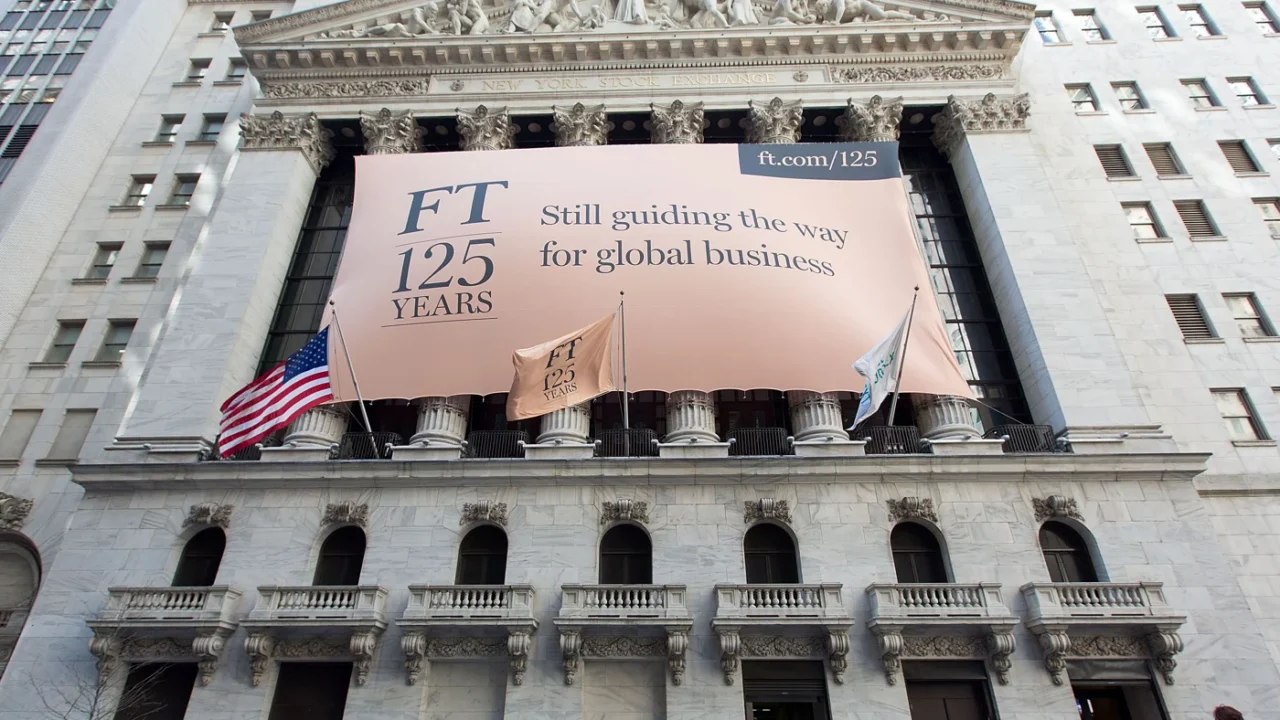
Photograph: FT ringing the Closing Bell at the NYSE (8741695960).jpg — Financial Times — CC BY 2.0 (resized and converted to WebP).

Educational notice
This content is for educational and informational purposes. It does not constitute financial advice or an investment recommendation.