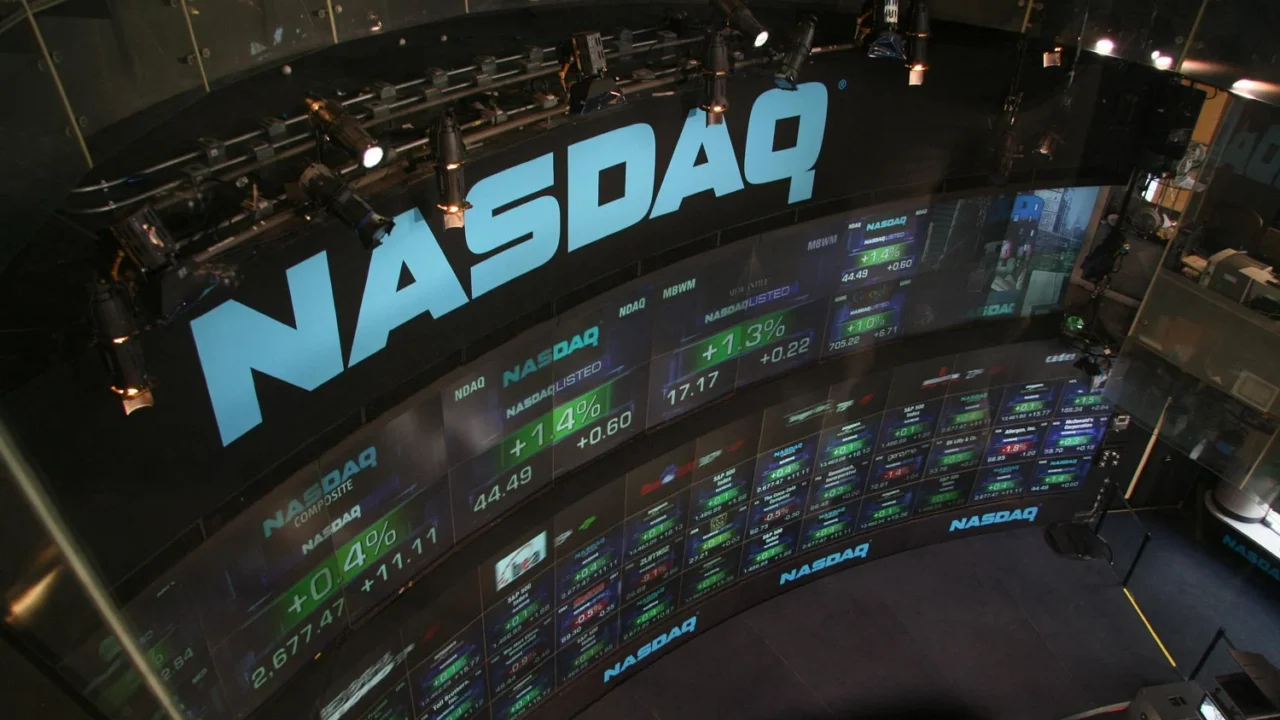
When a news report announces that «the Nasdaq has risen», it is often oversimplifying. The Nasdaq is an exchange, but it is also the name that appears on different indices. And these indices do not represent exactly the same companies.
Exchange, Composite, and Nasdaq-100: they are not the same
The Nasdaq exchange is a market where shares and other instruments are traded. The Nasdaq Composite is a broad index that tracks a large part of the values listed on this exchange. The Nasdaq-100 groups large non-financial companies according to its own selection and weighting rules. It does not include everything that is listed on the Nasdaq.
That is why two headlines about the Nasdaq can appear contradictory: one may refer to the Composite and the other to the Nasdaq-100. Nasdaq itself published an explanation of these differences in 2026.
What does it mean for an index to be weighted?
In a market-capitalisation-weighted index, companies with a higher market value tend to carry more weight. Price movements in a handful of large companies can therefore have a substantial effect on the overall result.
In a fictional example, an index has two companies. The first accounts for 80% of its value and falls 5%; the second accounts for 20% and rises 10%. The approximate result is −2%: (0.8 × −5%) + (0.2 × 10%). The second company rises twice as much as the first falls, but it carries less weight.
En índexs reals hi ha regles més complexes i, en el Nasdaq-100, límits de concentració i revisions periòdiques. L’exemple només serveix per entendre la lògica.
Why does it weigh so heavily in technology news?
The Nasdaq includes highly influential technology companies, but it is incorrect to reduce it to ‘all the world’s tech stocks’. There are companies from other sectors and many technology companies that trade on other exchanges or are not yet listed.
Indices also reflect expectations about future profits, interest rates, and risk. If investors rapidly change what they are willing to pay for future results, share prices can move strongly even if the daily activity of the companies changes little.
How to interpret news about an index?
Before drawing conclusions, check four data points: which specific index is mentioned, over what period the variation is calculated, which companies explain the movement, and whether the news compares returns in the same currency.
The key idea: the Nasdaq is a useful thermometer, but you need to know which thermometer you are looking at and what weighs more.
Why can a headline saying «the Nasdaq falls» be misleading?
Imagine that the ten largest companies in an index concentrate a significant portion of their value. Even if hundreds of small companies have a good day, a sharp drop in the giants can leave the index in the negative. This does not mean that most companies have fallen, only that those that weigh more have dragged down the weighted average.
It is also necessary to distinguish the index from the product that replicates it. An ETF may use other mechanisms, charge fees, and trade in a currency different from the reference one. One should not confuse a «index that rises by 3%» with the net return and in euros of a specific investment.
A good economic explanation always states which Nasdaq is being compared, in which currency, and over what time interval.
The same name can hide different investments.
When an application displays «Nasdaq», it may be referring to the stock exchange where shares are traded, the Nasdaq Composite index, or the Nasdaq-100. The latter is particularly well-known among those who follow technology companies, but it does not accurately represent the entire global technology sector. The index includes large non-financial companies listed on the Nasdaq; it may also contain businesses in consumer goods, biotechnology, or telecommunications. Furthermore, important technology companies may be listed on other exchanges and thus fall outside the index.
The difference is more significant than it appears. One news item might state that «the Nasdaq has risen by 2%» referring to the Composite, while at the same time, a fund tracking the Nasdaq-100 may have risen by a different percentage. This divergence does not imply that the fund is performing poorly: it may stem from the methodology and the companies included in each index.
Nasdaq published an official explanation of the differences between the two indices in June 2026, particularly regarding new companies going public and concentration rules. It is a useful reference to verify which indicator appears in a headline: https://www.nasdaq.com/newsroom/nasdaq-composite-vs-nasdaq-100-what-investors-should-know.
How can a single company move an index?
In a market-capitalisation-weighted index, larger companies tend to have a greater influence on the result. Consider a hypothetical index consisting of only three companies: A accounts for 60%, B accounts for 30% and C accounts for 10%. If A rises by 5%, B falls by 2% and C remains unchanged, the approximate performance of the whole is:
0.60 × 5% + 0.30 × (−2%) + 0.10 × 0% = +2.4%.
Therefore, the index could rise by 2.4% even if one of the three companies had fallen and another had remained unchanged. If, instead of three companies, there are hundreds, the principle remains the same. Composition and concentration are as important as the number of companies. This explains why «the market rises» does not necessarily mean that the majority of shares have risen.
Why is the Nasdaq-100 not a neutral portrait of the economy?
The Nasdaq-100 selects companies based on listing criteria, size and eligibility, and applies a specific weighting and rebalancing methodology. The activity of the companies that enter it is international, even if their headquarters or listing is in North America. Therefore, a change in the euro-dollar exchange rate, expectations about the demand for chips or the cost of capital can affect share prices without there having been an immediate change in the consumption of North American households.
The index does not include all industries with the same weight. If a company dominates a significant part of the semiconductor market, its sales review can influence the index far more than negative news about many small companies. To read it correctly, one must also look at the sector breakdown, the evolution of the smaller companies, and the breadth of the market, not just a final figure.
What is a person buying when they «invest in the Nasdaq»?
An index is a calculated indicator; it is normally not bought directly. What can be acquired is a product that attempts to replicate it, such as an index fund or an ETF. This product incurs fees, taxation, currency conversion, and possible differences relative to the index. One must also check whether it follows the Nasdaq-100, the Composite, or a sectoral version. Two products with «Nasdaq» in the name are not necessarily equivalent.
If the product is denominated in euros but the companies trade in dollars, the investor’s return in euros may vary with the exchange rate, unless there is a specific hedging policy. For example, a hypothetical 8% rise in dollar stocks could translate into less than 8% in euros if the dollar loses value during that period. This is not an error of the index, but another dimension of the investment.
Four readings that we should not confuse
An index point is a unit of its calculation, not a dollar that an investor has gained. A percentage increase measures evolution relative to a previous moment. Return with dividends may differ from price variation if the calculation incorporates reinvestment. And personal return depends on the entry date, the product used, expenses, and the reference currency.
Therefore, in the face of a headline such as «the Nasdaq breaks a record», a much more informative question is: which Nasdaq, with what weights, in what currency, and compared to which period?
Sources and supplementary reading
- https://www.nasdaq.com/newsroom/nasdaq-composite-vs-nasdaq-100-what-investors-should-know
- https://www.investor.gov/introduction-investing/investing-basics/glossary/market-capitalization
Photograph: NASDAQ stock market display.jpg — bfishadow — CC BY 2.0 (resized and converted to WebP).

Educational notice
This content is for educational and informational purposes. It does not constitute financial advice or an investment recommendation.