You can end the year with exactly €1,000 in your account, yet still be able to buy fewer things. This is what happens when prices rise and savings do not grow at the same rate. Inflation is a general increase in the prices of a representative basket of goods and services, not the isolated rise of a single product.
Balance and purchasing power measure different things
The balance shows how many euros you have. Purchasing power indicates how many products and services you can buy with those euros. The ECB explains that inflation reduces the value of money over time. Therefore, looking only at whether the balance has increased can give a misleading impression.
Imagine a student saves €2,000 in an account that pays no interest. If the price of their usual basket rises by 4% over a year, they would need €2,080 to buy the same things. The original €2,000 would buy roughly €1,923 worth of goods at last year’s prices (€2,000 / 1.04). The loss of purchasing power is about €77 in starting-year euros.
What if the account pays interest?
Suppose the same deposit pays a nominal 2% before tax and fees. The balance would be €2,040, but with inflation of 4%, its real value would be about €1,962 in starting-year euros. The exact real return is (1.02 / 1.04) − 1 ≈ −1.92%.
That calculation shows how a positive interest rate can still leave you worse off in real terms. And inflation of 0% does not bring prices back to their earlier level: it means that prices overall stopped rising during the period measured.
Your household can experience a different rate of inflation from the average
The ECB reminds us that official indicators use a weighted basket. A household that devotes much of its income to rent and another that owns its home may experience different impacts, even in the face of the same general data published.
To carry out a personal exercise without sensitive data, compare the prices of five recurring purchases, calculate what they weigh in your budget, and observe their evolution. It will not replace the official index, but it will help you understand why inflation does not affect everyone equally.
What should be avoided?
Saving should not be confused with assuming any risk. Seeking returns in volatile products can lead to nominal losses greater than the inflation that was intended to be offset. Liquidity, time horizon, and risk are different variables.
The key idea: to know whether savings maintain their value, compare the growth of the balance with the growth of the prices of what you need to buy.
Calculate the impact with a daily purchase
Imagine that over the past year you spent €50 a week on an identical shopping basket, and now you spend €53. That represents an increase of 6%. If you kept the same weekly budget, you would now need to reduce quantities, substitute products, or absorb higher costs. Over a year of 52 weeks, the difference of €3 represents an additional €156 to maintain that specific purchase.
This is a personal measure, not the official CPI. It only serves if you compare equivalent qualities and quantities. A change in brand, package size, or promotions can distort the example.
The utility of this calculation is that it connects a macroeconomic news item with a real budget decision without turning general statistics into a supposed universal experience.
Inflation does not make euros disappear: it changes what you can buy
When the balance of a bank account remains at €5,000, the number of euros is the same today as it was a year ago. However, if goods and services have become more expensive, that money buys less. This is a simple distinction with important consequences: saving a nominal amount does not necessarily mean preserving the standard of life it represents.
This does not mean that all purchases cost the same. The published inflation rate summarises a representative basket, whereas each family has different habits. A household that devotes an important part of its income to heating may notice especially a rise in energy prices. Another that uses a car almost never will perceive the changes in fuel prices differently. The European Central Bank reminds us that the average indicator assigns weights according to consumers’ expenditure, but the personal composition of the basket is not identical for everyone.
How much purchasing power is lost over several years?
Imagine savings of €10,000 that do not earn interest. If prices rise by 3% annually over five years, a bundle of goods that costs €10,000 today will cost approximately €11,592.74. This is the result of multiplying 10,000 by 1.03^5.
To find the final purchasing power of the €10,000 in initial-year euros, one must perform the inverse calculation: 10,000 / 1.03^5, approximately €8,626. The bank balance remains at €10,000, but it represents a smaller quantity of goods and services. This example is hypothetical: it is not a prediction of real inflation.
| Any | Cost of an initial basket of €10,000 with a hypothetical inflation rate of 3% |
|---|---|
| Today | 10,000.00 € |
| 1 | 10,300.00 € |
| 2 | 10,609.00 € |
| 3 | 10,927.27 € |
| 4 | 11,255.09 € |
| 5 | 11,592.74 € |
The effect is not linear. After the first year, the next increase is applied to the already inflated prices. This accumulation explains why moderate annual variations can have a notable impact if repeated over a long period.
How does inflation affect a household budget?
Consider a family with a net monthly income of €2,400, spending €900 on housing, €450 on food, €250 on transport, €300 on utilities, and €500 on other items. If the budget increases uniformly by 5% while income remains unchanged, the total expenditure of €2,400 would rise to €2,520, creating a monthly shortfall of €120. In reality, categories do not rise at the same rate, and families can adjust consumption, but the calculation demonstrates why inflation can pressure daily decisions even without an extraordinary purchase.
A useful way to analyse this is to compare the budget from the last twelve months with the current one using the same categories. If only the supermarket receipt from one week is compared with another, promotions, quantities, and products can alter the conclusion. The more consistent the comparison, the more informative it will be.
Why does a fall in inflation not mean that prices fall?
When news reports that inflation has fallen from 6% to 2%, it normally indicates that prices continue to rise, but more slowly. If a basket of goods cost €100, after one year at 6% it costs €106. If the following year inflation is 2%, it rises to €108.12. It does not return to €102 or €100. A general fall in the price level is called deflation and is a different situation.
This distinction helps interpret common conversations: a lower inflation indicator can be good news for interest rate increases, but it does not automatically restore purchasing power lost in previous periods.
What changes when a savings account pays interest?
If a deposit offers a 2% nominal rate and inflation is 3%, the approximate real return is negative. With €10,000, the gross interest would be €200 in a year and the balance would reach €10,200, but a basket of goods initially costing €10,000 would cost €10,300. Savings have grown in euros, but have lost purchasing power. Taxes and possible fees should also be considered, which can reduce the final available amount.
This does not mean that the solution for all savers is to invest in risky assets. Money needed in the short term requires prioritising liquidity and security, while long-term goals present other trade-offs. The correct comparison separates nominal security, return after costs, and purchasing power.
A rigorous way to explain inflation in a news story
Before stating that savings «have lost 3%», specify whether you are referring to general inflation, the price increase of your basket, or the real return of a product. These are related but distinct magnitudes. Use a start date, an end date, a currency, and the same set of products. This will allow the reader to reproduce the calculation and understand what was actually measured.
Explanatory source from the ECB: https://www.ecb.europa.eu/ecb-and-you/explainers/tell-me-more/html/what_is_inflation.en.html.
Sources and supplementary reading
- https://www.ecb.europa.eu/ecb-and-you/explainers/tell-me-more/html/what_is_inflation.en.html
- https://www.ecb.europa.eu/ecb-and-you/explainers/tell-me/html/nominal_and_real_interest_rates.ff.html
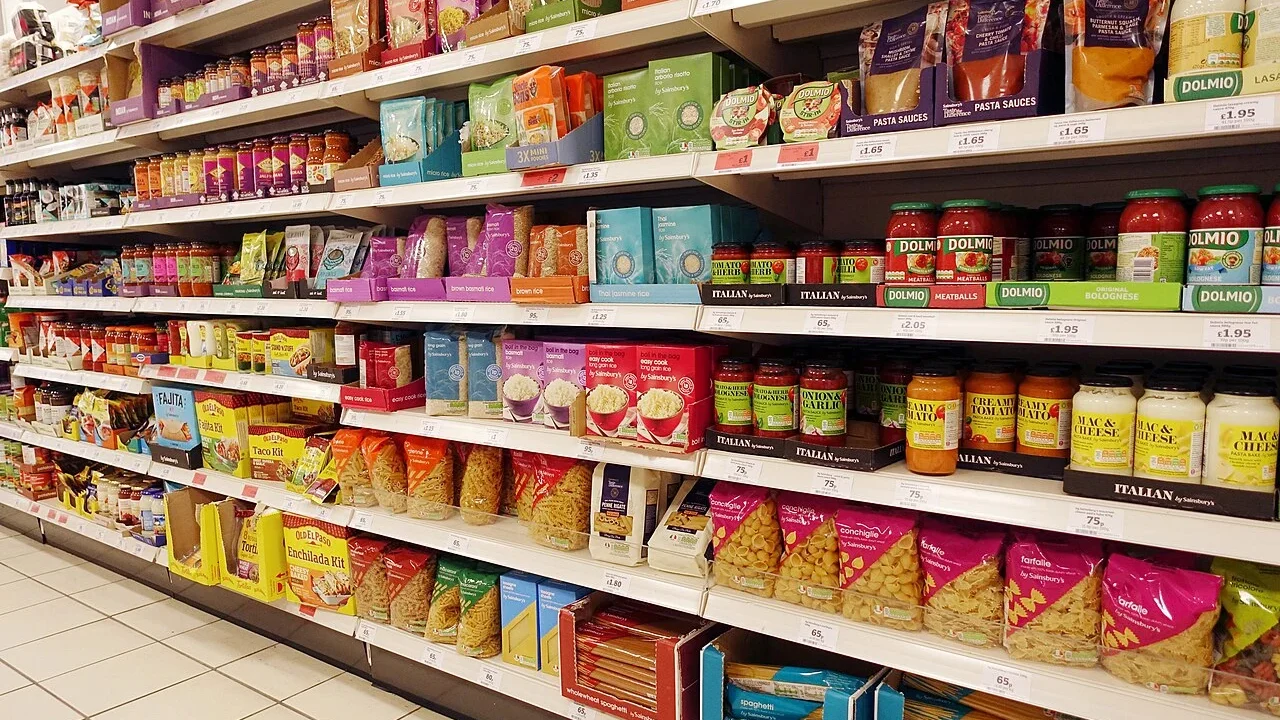
Photograph: Food in supermarket.jpg — Tiia Monto — CC BY-SA 3.0 (resized and converted to WebP).

Educational notice
This content is for educational and informational purposes. It does not constitute financial advice or an investment recommendation.