You receive a message that appears to be from your bank: ‘We have blocked your account. Verify it within 30 minutes.’ It features a correct logo and a link resembling the usual domain. The problem is that the visual identity can be copied, and the urgency is designed to make you act before verifying anything.
What is the scammer trying to achieve?
Impersonation involves pretending to be a company, administration, or trusted person to obtain money, passwords, verification codes, or other data. It can arrive via email, SMS, phone call, instant messaging, or fraudulent advertising.
The first message is not usually the final objective. It is an entry point. Once the victim visits a fake page or initiates a conversation, the attacker can ask them to confirm data, install a program, or authorise an operation.
Example: a very well-constructed fake invoice
Imagine a business receiving an invoice for €1,200 apparently sent by a regular supplier. The email appears authentic, but the bank account number for payment has changed. If the responsible person pays without confirming the modification through an independent channel, they may end up sending the money to the fraudster.
This type of fraud does not necessarily require access to the business’s systems. Sometimes it is enough to correctly mimic a commercial conversation and take advantage of payment routines.
How can this mechanism be broken?
INCIBE recommends contacting businesses through channels you already know and have verified, not through the phone number or link in the unexpected message. It also warns that the phone number displayed on the screen may be forged.
For a small business, it may help to establish a simple rule: any change of bank account for a supplier requires additional independent verification. It does not prevent all fraud, but it makes the most common type more difficult: exploiting an apparently urgent order.
What to do if you have already paid?
Contact the financial institution immediately through its official channel to report the incident and ask about blocking or recovery options. Keep all evidence and messages without continuing to interact with the suspected fraudster. Depending on the case, you may need to file a complaint and report the fraud to the relevant authorities.
There is no universal guarantee of recovering authorised transfers, so acting quickly is important.
Key idea: The authenticity of a logo or the tone of a message does not depend on who sends it. Verification through an independent channel is the decisive step.
Why does time pressure work?
Frauds seek to make the victim make a decision before verifying it. They may announce an immediate fine, a withheld payment, or the loss of access to an account. If a message demands action «in ten minutes», this is not proof of legitimate urgency; it is another reason to verify its origin.
A simple protocol for families or businesses is to agree beforehand that no change of banking details will be validated through a single channel. If someone requests an unexpected transfer impersonating someone known, it is preferable to call the number we already have saved, not the one appearing in the message.
Technology helps filter frauds, but an independent verification breaks the central element of the deception: making the victim believe the attacker is already a trusted person.
How is a credible-looking impersonation constructed?
Corporate impersonation scams use real information to create an appearance of normality. The attacker may look up a supplier’s name, copy an email signature, use a similar font, and refer to an invoice that actually exists. When the message arrives during a workday, the recipient may recognise several correct details and assume the request is also legitimate.
The critical point is often a change in behaviour: sending money to a new account, accessing an alternative page, providing a verification code, or approving a contractual change without the usual process. Scammers do not need to forge all elements of a company; they may only need to insert an instruction that goes unnoticed within an exchange that appears legitimate.
Example: the correct invoice with the wrong IBAN
A small company expects to pay €3,800 for an order. It receives an email apparently from the supplier with the usual invoice and a message: ‘We have changed banks; use this IBAN to avoid delays’. The sender uses a domain visually similar to the real one and knows the project name. The person managing payments may be tempted to process it immediately, especially if the email includes a deadline.
The most important protection is not a sophisticated tool, but an out-of-channel verification of the compromised channel. You must call the provider’s number already listed in the contract or the provider system, not the one appearing in the suspicious email. An internal procedure may require additional validation for any change of bank account, even if the amount is relatively small.
In this hypothetical case, if the person had called the usual number and the provider had confirmed there was no change, the fraud would have been stopped before the payment. The time spent on verification is insignificant compared to the potential cost of recovering a fraudulent transfer.
What evidence is insufficient to consider a message authentic?
A logo can be copied. A signature with the full name also. The presence of an HTTPS padlock on a page only indicates that there is an encrypted connection to the visited domain; it does not demonstrate that the company appearing is the one it claims to be. A convincing voice call also does not guarantee identity, especially if the phone number displayed on the screen can be technically spoofed.
Even an email that is part of a real conversation can be dangerous if an account has been compromised. That is why it is better to validate instruction changes rather than relying solely on the appearance of the channel. In business environments, an independent verification of bank data is usually more robust than a simple email confirmation question.
Three types of pressure that are often used
The first is urgency: ‘if you don’t pay today, the service will be cancelled’. The second is authority: ‘management is asking for this’ or ‘this is a mandatory review’. The third is forced confidentiality: ‘do not discuss this with anyone until we close the deal’. All three aim to reduce the verification time and prevent other people from detecting inconsistencies.
This pattern helps to spot scams even when there are no spelling errors. A well-written email can be fraudulent, and a legitimate message can contain mistakes. The content of the request and the verification procedure are more reliable indicators than the style.
What to do in the first hour if money has already been transferred?
If a suspicious transfer has been made, it is advisable to contact the banking institution immediately through official channels, explain the situation, and ask whether it is possible to activate recovery procedures or notify the receiving institution. Recovery is not guaranteed, especially in executed transfers, but acting quickly can improve the chances. It is also necessary to preserve emails, account numbers, receipts, screenshots, and timestamps; avoid deleting messages that could serve as evidence; and report the incident to the competent authorities.
If credentials have been provided, they must be changed via the official access channel, sessions revoked whenever possible, and authentication factors reviewed. If an executable attachment has been opened, it may be necessary to isolate the device from the network and contact technical support to prevent the incident from continuing.
A simple policy for a small business
A preventive procedure could require: a central provider registry; double validation for IBAN changes; telephone verification on a known number; separation of roles between the person entering an invoice and the person approving payment; and retention of evidence. It is not necessary to start with expensive infrastructure to apply these rules, but they must be maintained even on busy days.
The conclusion is that impersonation exploits trust processes above all, not just IT errors. A good email filter can reduce incidents, but the last line of defence is to verify important changes via an independent channel.
Sources and supplementary reading
- https://www.incibe.es/sites/default/files/2025-07/Infografia_10PasosProtegerPyme_FraudeDelCEO_INCIBE.pdf
- https://www.incibe.es/aprendeciberseguridad/phishing
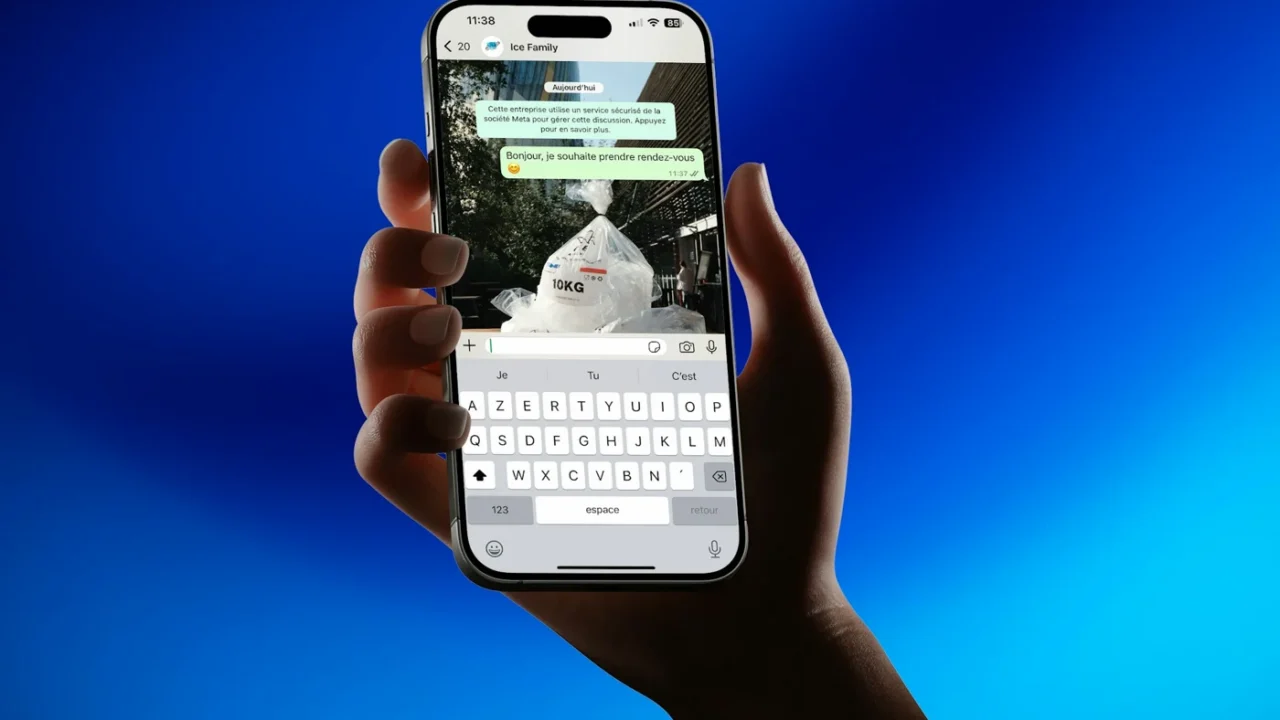
Photograph: Hand holding smartphone showing messaging app — Ice Family — Llicència Unsplash (resized and converted to WebP).
Educational notice
This content is for educational and informational purposes. It does not constitute financial advice or an investment recommendation.